
Financial Evaluator — AI Business Modelling for HK
by Anthony Yau
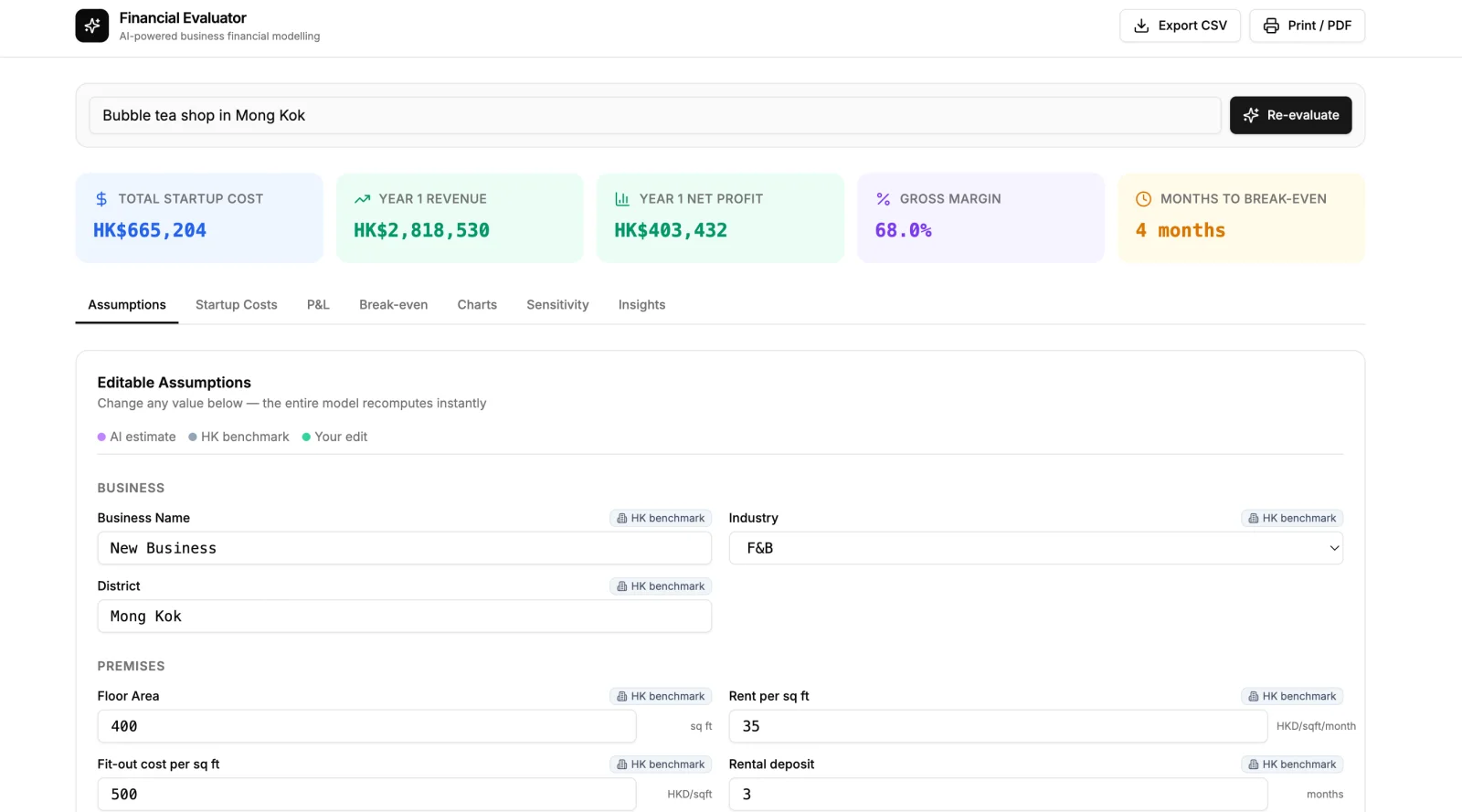
Financial Evaluator turns a single sentence into a full financial model. Type "Bubble tea shop in Mong Kok" or "Co-working space in Kwun Tong" and it returns total startup cost, year-one revenue and net profit, gross margin and months to break-even — then lets you interrogate every number behind them across tabs for Assumptions, Startup Costs, P&L, Break-even, Charts, Sensitivity and Insights, exportable to CSV or PDF.
The architecture is the real achievement, and it's a genuinely sophisticated piece of thinking. The work is split across three layers with strictly separated responsibilities:
• The AI drafts the assumptions — floor area, rent per square foot, fit-out cost, headcount, pricing — using its knowledge of the industry and district you named. • Hong Kong market benchmarks sanity-check those drafts, so the estimates are anchored to real local rates rather than whatever the model felt like producing. • Deterministic TypeScript then computes the model. Every figure on screen is plain arithmetic over the assumptions, running in your browser.
Crucially, the language model never outputs a profit number. It only proposes editable inputs — and the app makes that visible, tagging each field as an AI estimate, an HK benchmark, or your own edit. Change any value and the entire model recomputes instantly.
That design choice is what separates this from the many AI tools that simply ask a chatbot for a forecast. A finance reviewer shown an LLM-generated profit figure will distrust it immediately, and should — the number has no derivation and can't be checked. By constraining the AI to assumptions and doing the maths deterministically, Anthony built something **auditable**: you can trace any output back through the arithmetic to a specific input, and disagree with that input directly. That is precisely the property an audit or accounting employer is looking for, and it's a distinction most professionals building AI tools still get wrong.
The product is honest about its limits, too. It states plainly that figures are projections rather than guarantees, that the model is deterministic with AI proposing only assumptions, and that users should consult a qualified advisor before making financial decisions — the kind of disclosure that signals someone who understands the domain they're building for.
More like this
Grid Watch — Live F1 Standings, Telemetry & Strategy
by Cyrus Lee
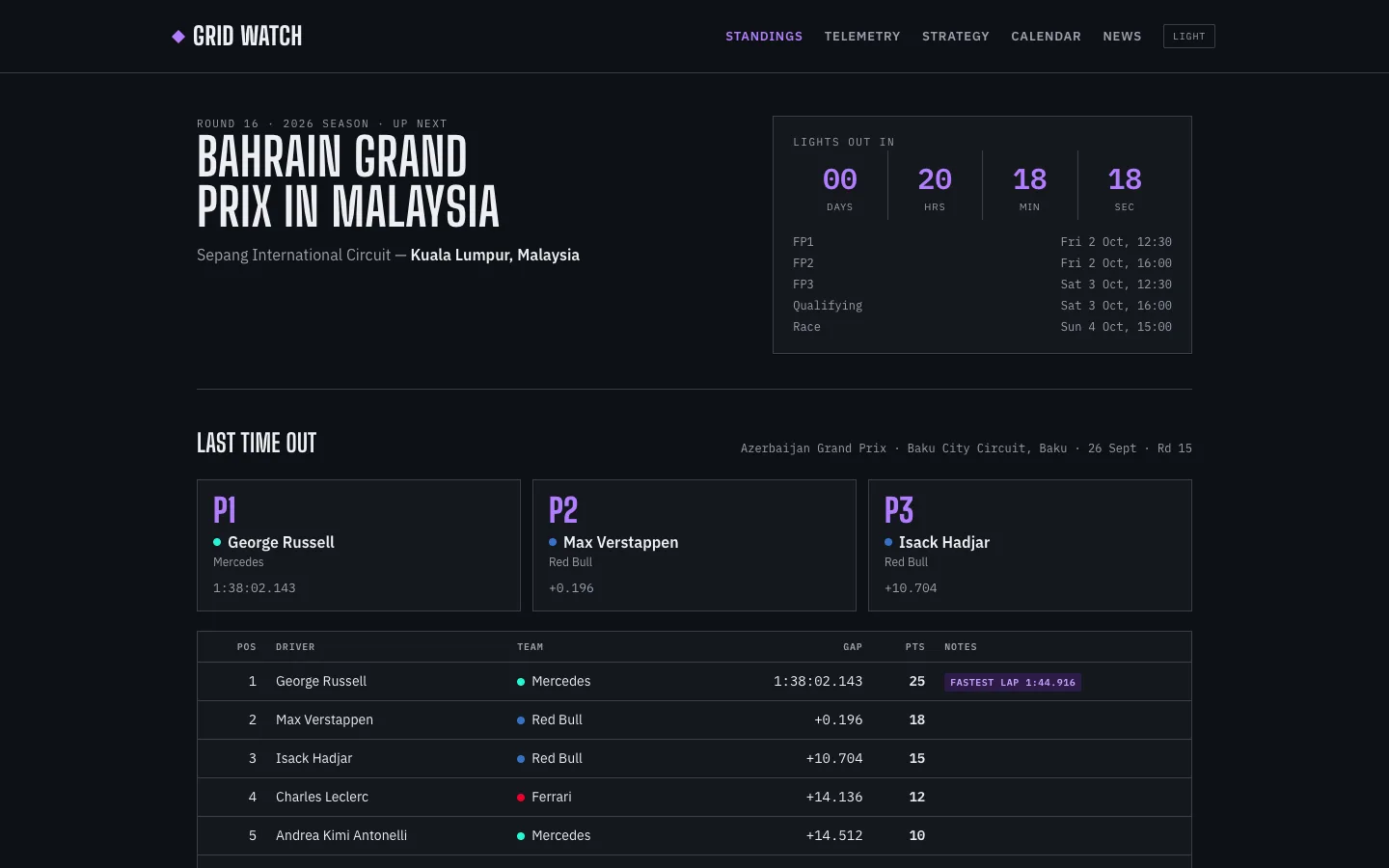
A live Formula 1 dashboard: championship standings and a race-weekend countdown, lap-by-lap telemetry with a corner-by-corner braking comparison of any two drivers, and tyre strategies projected from the weekend's own long-run pace.

What's for Dinner — Quick Pick & Nutrition Coach
by Alvin Ng
One question answered at two depths: tap what's in the fridge for a dish you can cook right now, or build the plate properly against calorie and protein targets calculated from your own body.

Baseline — Your Assistant Coach, In Your Pocket
by Diana Lam
An AI basketball training platform for Hong Kong players — personalised drills credited to real coaches, streak-driven session logging, matchup game-plans and a coach marketplace, with a full Supabase auth and onboarding flow behind it.